Replacing a Lifetime of Learning
"I hope the Manual continues to educate and inspire." – Michael A. Dirr
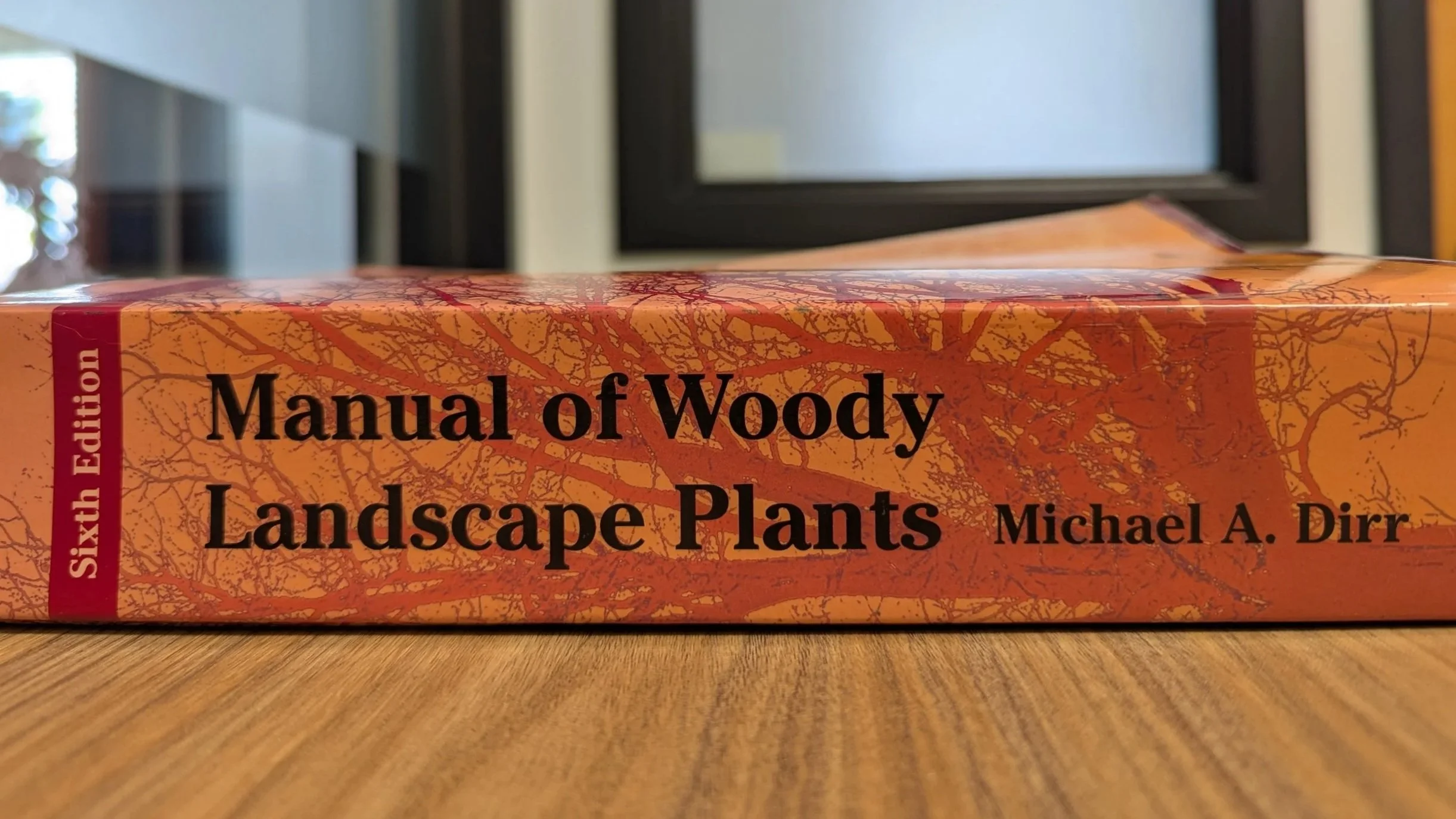
"Are you studying or something?"
That's what someone asked when they passed my office.
Open on my desk was Michael Dirr's "Manual of Woody Landscape Plants".
The “Manual” is over 1,300 pages and looks like something you'd only open when necessary.
I bought it over a decade ago while studying landscape architecture at UMass.
I expected this book to help in at least a few classes focusing on plants. Usefulness beyond that was questionable.
But to my pleasant surprise, the "Manual of Woody Landscape Plants" has never lost relevance for me or my work.
It's relevant. That's unquestionable.
But is it a pleasure to read?
In many ways, it's not.
A more apt word would be rigorous.
Within the pages of the "Manual of Woody Landscape Plants", Michael Dirr goes to extraordinary lengths, includes in-depth descriptions, expounds on innumerable facts, and details the specifics of more plant species than I care to count.
So, engaging with this book is a form of study, whether you have an exam approaching or not. Dirr sets that tone specifically, through his own rigor.
Why does he do that?
In Dirr's words, "the Manual continues into its 34th year, always a work in progress, never quite reaching the finish-line…there is always one more new plant…or observational anecdote that should be included."
But let's pause there.
Dirr's commitment is clear. What's not clear is whether it's really necessary to read his book.
After all, can't you find all that information online?
It's true. Plant facts and descriptions, such as what you'd find in Dirr's "Manual", are available in many resources, online or not. This is especially true regarding any hard facts Dirr includes. Arguably, Dirr is more thorough, but you can find the information elsewhere nonetheless.
In other words, referencing a gigantic book when the same material exists on your phone is just nonsensical.
The "Manual of Woody Landscape Plants" is not unique in its ability to accurately describe plant species. But that's not the sole reason this book is a compelling read.
When I first started using this book for classes at UMass, one of my professors pointed out a section that Dirr included for many plants in the "Manual".
This section was not a specific part of any curriculum. Instead, it seemed to be something my professor really enjoyed, on a personal level, not because the section reveals more strict discipline on Dirr's part, but because it adds a sense of vibrance to the text that pure details never achieve.
"LANDSCAPE VALUE" is the section’s name.
In it, Dirr goes beyond facts and figures and doesn't hold back. He shares his opinions, which Dirr himself describes as "arbitrary judgment".
Still, these supposedly arbitrary judgments are what give this “Manual” a sense of life and humanity that arises through the expression of a lived experience. It’s these sections that make many other resources look, comparatively, soulless.
The content in "LANDSCAPE VALUE" exists because Dirr did more than write a "Manual of Woody Landscape Plants". He used his writing to reveal a passion-filled life. Then he chose to share what he learned in a way that has delighted countless readers, many of whom must have assumed they were just studying.
If nothing else, the "Manual" makes it clear that Dirr is an expert on plants, more so than the rest of us.
What Dirr makes clear is that, as much of an expert as he may be, his work will never really be done.
That's the sentiment that leads to a lifetime of learning and seems worth following regardless of profession. Be passionate about what you do. Find and share the joy that comes from that.
At least, that's what Dirr does.
Despite that, even as a landscape designer, it's too easy to overlook the importance of selecting the right plants for a project. But the reality is that the plants you grow today, with luck, will impact the landscape and those who use it for decades, even centuries, to come.
That's why I continue to use Dirr's book. That's why, in a way, it's necessary.
Send Me a Message
Use the form below to send me a message if you'd like to work with me or learn more about my experience.